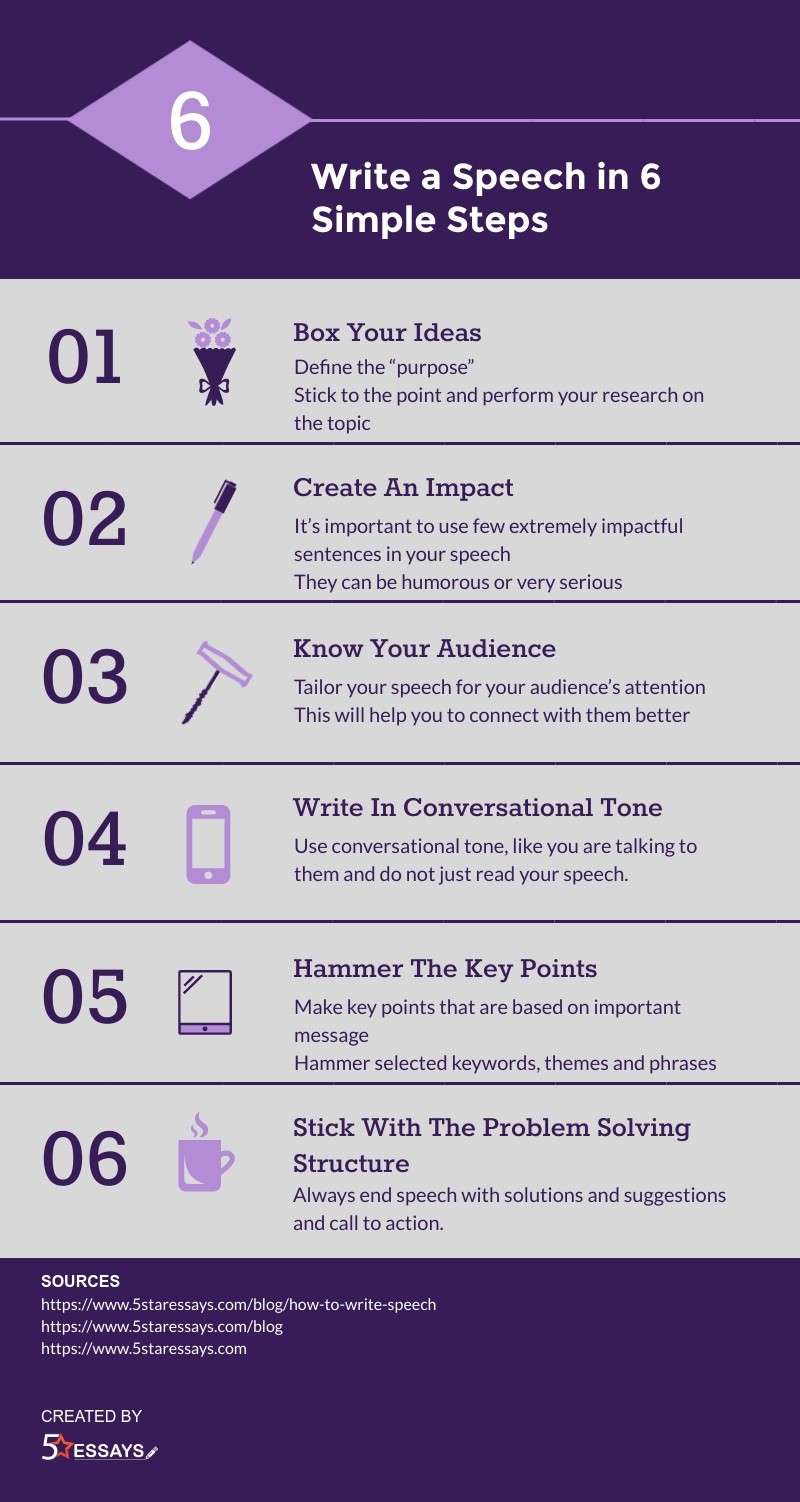
Knowing Speech Writing and It's Types
If you’re on the internet looking for help with writing a speech.
Then you must be in high school and probably got assigned a speech for your English class.
Well, speech writing can be a hard nut to crack, especially when you don’t possess the writing skills, right?
That’s not true!
You don’t have to be good with words to come up with an interesting speech.
Writing a speech is an art and requires more than just knowing your way around words --- lucky for you it can be learnt.
Informative speeches are made to educate the audience about an unfamiliar or new subject. It does not require visual aid, but the information is presented in the form of facts and figures.
An example of an informative speech is a college tour guide showing the way around college to prospective students and presenting them with facts and figures regarding the campus.
Persuasive speech papers as the name suggests persuade the audience to agree with the speaker’s point of view. The speaker gets them to believe that his opinion is the right one. This again is done by presenting convincing and solid evidence to back the argument.
Debate speeches in simple words are arguments with certain rules and regulations. They differ from persuasive speeches as the goal isn’t to get the other party to agree with your opinion; instead, you present arguments to justify yourself.
In a debate speech, both parties get the same amount of time to explain their issue and why they are right about a certain matter.
Taking part in debate speeches can build several skills such as leadership skills, time management, critical thinking, public speaking, initiative skills, also learning to remain calm under pressure.
Now that you have understood the basic types of speeches and how they differ from one another you must have noticed the one thing that remained constant throughout --- the audience.
The key to writing an effective speech is to knowing your audience and delivering your message clearly and effectively.
Many famous speakers forget about the audience and just talk about themselves. They allow their speech to be guided by their personal needs instead of their readers.
After choosing the right topic, the next step is to start with the speech itself. Generally, a speech comprises five main points and relevant evidence and the conclusion.
Organise your speech and make an outlines highlighting these main points. This will enable you to have everything under control leaving no room for panic and chaos.
Outline your ideas and then check whether the speech is complete and the flow makes sense.
Use transitions to maintain the flow of your speech and help the audience understand the connection between each point.
Don’t abruptly move on to the next point use the following transition words:
Before, after, then, next, secondly, in addition to that, in the following month, etc.
Conclude your speech with a call-to-action, encourage the audience to find out more about the topic. Tell them how they can participate in finding out the solution to your mentioned problem.